


La bibliothèque numérique des universités publiques du Sénégal

- A plain-English guide to the disastrous practical consequences of the bizarre legal doctrine of “corporate personhood”— enshrined most recently in the Supreme Court’s Citizens United decision
- Features a constitutional amendment designed to overturn Citizens United and restore the government to the people
- Includes a “tool kit” to help citizens mount a grassroots campaign to pass the People’s Rights amendment
The January 2010 Supreme Court Citizens United v. Federal Election Commission decision marked a culminating victory for the legal doctrine of corporate personhood. Corporations, as legal persons, are now entitled to exercise their alleged free-speech rights in the form of campaign spending, effectively enabling corporate domination of the electoral process.
Jeffrey Clements uncovers the roots, expansion, and far-reaching effects of the strange and destructive idea, which flies in the face of not only all common sense but, Clements shows, most of American legal history, from 1787 to the 1970s. He details its impact on the American political landscape, economy, job market, environment, and public health—and how it permeates our daily lives, from the quality of air we breathe to the types of jobs we can get to the politicians we elect. Most importantly, he offers a solution: a constitutional amendment to reverse Citizens United and tools readers can use to mount a grassroots drive to get it passed.
Overturning Citizens United is not about a triumph of one political ideology over another—it’s about restoring the democratic principles on which America was built. Republican president Theodore Roosevelt and conservative Supreme Court Chief Justice William Rehnquist both vocally opposed the idea of corporate personhood. Community by community, state by state, we can cross party and ideological lines to form a united front against unchecked corporate power in America—and reinstate a government that is truly of, by, and for the people.

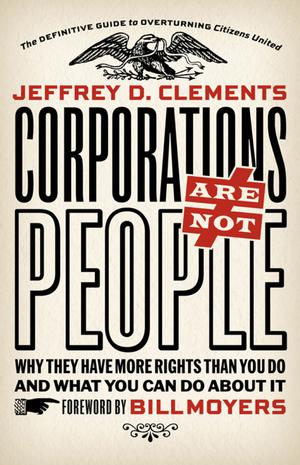


Auteur(s): Clements, Jeffrey D.
Editeur: Berrett-Koehler Publishers
Année de Publication: 2012
pages: 240
Langue: Anglais
ISBN: 978-1-60994-105-5
eISBN: 978-1-60994-106-2
- A plain-English guide to the disastrous practical consequences of the bizarre legal doctrine of “corporate personhood”— enshrined most recently in the Supreme Court’s Citizens United decision
- Features a constitutional amendment designed to overturn Citizens United and restore the government to the people
- Includes a “tool kit” to help citizens mount a grassroots campaign to pass the People’s Rights amendment
The January 2010 Supreme Court Citizens United v. Federal Election Commission decision marked a culminating victory for the legal doctrine of corporate personhood. Corporations, as legal persons, are now entitled to exercise their alleged free-speech rights in the form of campaign spending, effectively enabling corporate domination of the electoral process.
Jeffrey Clements uncovers the roots, expansion, and far-reaching effects of the strange and destructive idea, which flies in the face of not only all common sense but, Clements shows, most of American legal history, from 1787 to the 1970s. He details its impact on the American political landscape, economy, job market, environment, and public health—and how it permeates our daily lives, from the quality of air we breathe to the types of jobs we can get to the politicians we elect. Most importantly, he offers a solution: a constitutional amendment to reverse Citizens United and tools readers can use to mount a grassroots drive to get it passed.
Overturning Citizens United is not about a triumph of one political ideology over another—it’s about restoring the democratic principles on which America was built. Republican president Theodore Roosevelt and conservative Supreme Court Chief Justice William Rehnquist both vocally opposed the idea of corporate personhood. Community by community, state by state, we can cross party and ideological lines to form a united front against unchecked corporate power in America—and reinstate a government that is truly of, by, and for the people.



